
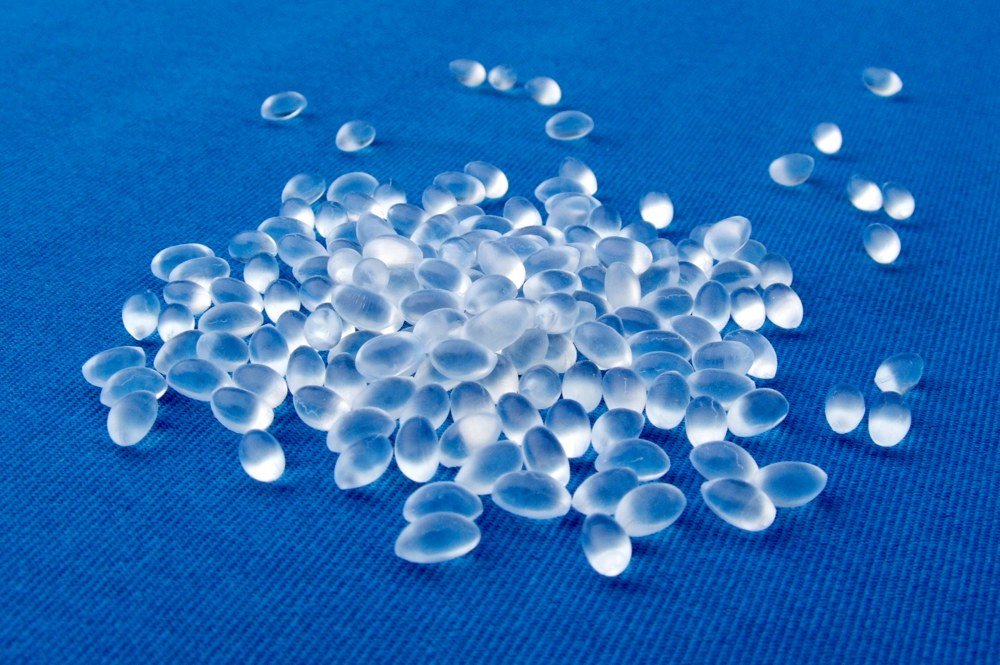
Understanding the material
Resin chemistry influences compatibility, crystallisation, activation and final bond behaviour. A solid adhesive resin may be designed for dissolution or a melt process, while a dispersion is developed for a waterborne route. The same broad PU designation can cover materials with substantially different processing requirements. Select the grade against a defined formulation brief.
Product Identity & Specifications
Chemical identity, physical characteristics and key specifications for Polyurethane Resin.
| Parameter | Description / value | Basis / application |
|---|---|---|
| Material identity | Polyurethane adhesive resin | Polymer family |
| Supplied form | Solid, solution or dispersion | Select the formulation route |
| Polymer chemistry | Grade-specific polyurethane | No universal molecular formula |
| Solid content | As supplied and on stated basis | Important for solutions and dispersions |
| Viscosity | Solution, dispersion or melt method | Conditions must be specified |
| Crystallisation | Grade-specific rate and behaviour | Setting and activation performance |
| Thermal activation | Resin / formulation specific | Validate in the complete adhesive |
| Solvent compatibility | Specified compatible solvent system | Dissolution and stability |
| Moisture | Controlled as required by grade | Processing and storage |
| Melt behaviour | Relevant to melt-processing grades | Not applicable to every PU resin |
| Colour / appearance | Grade-specific description | Finished-product appearance |
| Bond evaluation | Complete formulated adhesive | Raw-resin data alone are insufficient |
Identity and published standard
Polyurethane adhesive-resin grade specifications
Published manufacturer information distinguishes solventborne PU resins and thermoplastic adhesive raw materials. There is no single assay or activation value covering this entire family. Identify the supplied form and use the selected manufacturer’s specification for acceptance.
View published resin informationPublished resin-family information supports selection; the current TDS and COA define the offered grade.
For further information and current COA/specification, please contact us.
Request current COA & specificationApplications & functional benefits
Solventborne adhesive manufacture
Suitable solid or solution resins can be used in qualified solventborne formulations. Define the solvent system, target solids and application requirements.
Heat-activated bonding systems
Selected grades support thermally activated adhesives. Activation and bond development must be evaluated in the complete formulation and substrate combination.
Waterborne or melt routes
These require resins designed for the selected route. A generic solid resin should not be assumed equivalent to an aqueous dispersion or a melt-processing grade.
Supplied forms and formulation routes
| Grade / form | Main distinction | Selection consideration |
|---|---|---|
| Solid adhesive resin | Polymer supplied without a liquid carrier | Confirm dissolution or melt-processing suitability. |
| Resin solution | Polymer in an identified solvent system | Account for supplied solids and solvent compatibility. |
| Aqueous dispersion | Polymer dispersed in water | Use the appropriate waterborne formulation process. |
Formulation & processing
Begin with the formulation route
Specify solventborne, waterborne or melt processing before selecting a resin. This avoids comparisons between materials intended for different equipment and carrier systems.
Define viscosity conditions
A resin-solution viscosity depends on concentration, solvent and temperature. Compare values only when the measurement conditions are equivalent.
Qualify activation and compatibility
Evaluate crystallisation, film formation and bonding with the actual co-resins and additives. A change of resin can alter storage stability as well as final adhesion.
What to check in the specification
- Resin chemistry and supplied form
- Solution viscosity or melt-processing properties
- Crystallisation behaviour and activation requirements
- Solvent compatibility, moisture and formulation stability
Current product documentation
Request the current COA, specification sheet and SDS. Share any additional documentation required for your application.
Request documents for Polyurethane ResinPacking, storage & handling
Packing and quotation details
Discuss the required net weight, sample quantity and delivery schedule with SBS. Packaging should be compatible with the material and carry product, manufacturer and batch identification. Confirm the offered pack size and shelf-life or retest information in the quotation; these depend on the selected grade.
Storage and safe handling
Keep the material in compatible, closed packaging under the manufacturer’s stated conditions. Use the current SDS to set ventilation, personal protection and fire precautions; storage and shelf life depend on formulation.
Frequently asked questions
Can PU resin be applied directly as adhesive?
Only if the particular product is designed for that application. Most resin enquiries concern a raw material needing formulation.
Does every PU resin dissolve in the same solvent?
No. Solvent compatibility depends on polymer chemistry and the selected grade.
What documents are useful?
Request current TDS, SDS, COA or specification, supplied-form information and relevant viscosity or activation data.
Technical information sources
Need more information?
Contact SBS for further product details, current COA, specification, packing and a quotation for your requirement.
Contact SBS for details and documents