
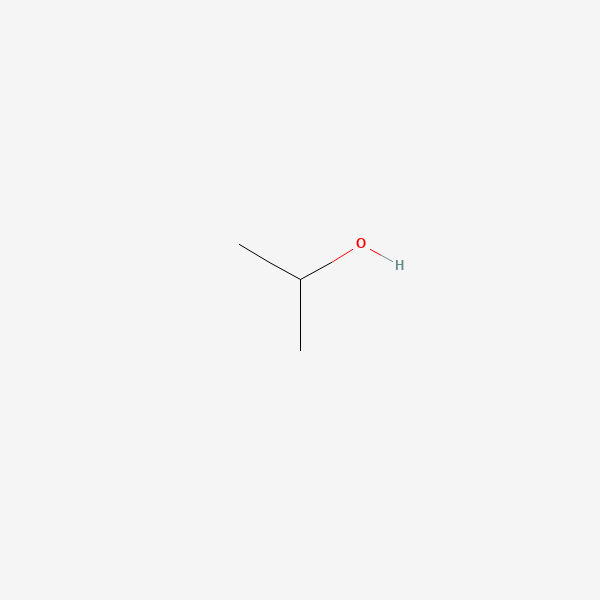
Understanding the material
A solvent specification should identify both its main component and the impurities relevant to the process. Water content, non-volatile residue and volatile contaminants can matter as much as nominal purity. Cleaning performance also depends on the equipment, soil and process conditions. Pharmaceutical or other special-purpose use requires the corresponding qualified grade.
Product Identity & Specifications
Chemical identity, physical characteristics and key specifications for Isopropyl Alcohol.
| Parameter | Description / value | Basis / application |
|---|---|---|
| Chemical name | Isopropyl alcohol / propan-2-ol | Also called IPA |
| CAS number | 67-63-0 | Chemical identity |
| Molecular formula | C₃H₈O | Single-component alcohol |
| Molar mass | 60.10 g/mol | Formula mass |
| Appearance | Colourless liquid | General solvent description |
| Water miscibility | Miscible with water | Concentration changes on dilution |
| Published USP definition | At least 99.0% isopropyl alcohol | High-purity material definition |
| Concentration basis | Mass or volume percentage as specified | Do not interchange w/w and v/v |
| Water content | Grade-specific maximum | Process compatibility |
| Non-volatile residue | Specified analytical limit | Cleaning and evaporation quality |
| Acidity / impurities | Defined by the selected standard | Current specification |
| Flammability | Flammable liquid and vapour | SDS-based handling controls |
Identity and published standard
USP–NF: Isopropyl Alcohol
The published USP definition specifies at least 99.0% isopropyl alcohol. A diluted IPA preparation requires its own concentration description and specification.
View published monographA published standard describes the material; conformity of the offered grade is confirmed through its current specification and COA.
For further information and current COA/specification, please contact us.
Request current COA & specificationApplications & functional benefits
Manufacturing solvent
Used where its solvent characteristics are compatible with the formulation or process. Verify the permitted impurity profile and residual-solvent requirements for the finished product.
Process cleaning
Selected grades can be evaluated for compatible equipment and surfaces. Cleaning validation should consider residue, drying and material compatibility.
Aqueous solvent systems
Water miscibility supports use in defined blends. State the required concentration and whether the percentage is by mass or volume.
High-purity IPA and application grades
| Grade / form | Main distinction | Selection consideration |
|---|---|---|
| High-purity IPA | Low water content with defined solvent assay | Choose the impurity limits required by the process. |
| Aqueous IPA blend | Intentional mixture of IPA and water | State concentration and w/w or v/v basis. |
| Special-purpose grade | Additional residue or impurity controls | Qualify against the intended manufacturing application. |
Formulation & processing
Keep concentration unambiguous
A 70% v/v blend is not a 70% w/w blend. Use the specified concentration basis and a controlled preparation method for any process dilution.
Check evaporation residues
Solvent evaporation can leave non-volatile material behind. Include a residue requirement when the cleaned surface or downstream process is sensitive to contamination.
Control ignition and vapour
Use compatible closed handling equipment, suitable ventilation and ignition control. Select protective equipment and storage arrangements from the current SDS.
What to check in the specification
- Identity and assay
- Water content and non-volatile residue
- Acidity and relevant volatile impurities
- Grade suitability for the intended process
Current product documentation
Request the current COA, specification sheet and SDS. Share any additional documentation required for your application.
Request documents for Isopropyl AlcoholPacking, storage & handling
Packing and quotation details
Discuss the required net weight, sample quantity and delivery schedule with SBS. Packaging should be compatible with the material and carry product, manufacturer and batch identification. Confirm the offered pack size and shelf-life or retest information in the quotation; these depend on the selected grade.
Storage and safe handling
Flammable liquid. Keep away from ignition sources and use suitable ventilation, compatible closed containers and the handling controls in the SDS.
Frequently asked questions
Is high-purity IPA the same as 70% IPA?
No. An aqueous blend includes intentionally added water and has different concentration and processing characteristics.
Does solvent grade establish disinfectant performance?
No. Efficacy depends on the complete product, concentration and validated application conditions.
What should I include in an enquiry?
Specify grade, concentration basis, water and residue requirements, pack size, quantity and delivery location.
Technical information sources
Need more information?
Contact SBS for further product details, current COA, specification, packing and a quotation for your requirement.
Contact SBS for details and documents