
Understanding the material
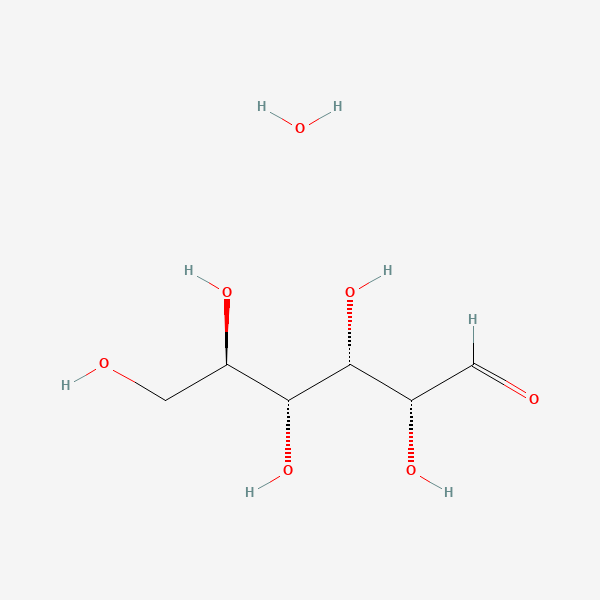
The water molecule is part of the crystal form, giving a formula mass of 198.17 g/mol rather than 180.16 g/mol for anhydrous dextrose. This distinction matters when converting a formulation between hydration forms. The published assay is calculated on an anhydrous basis, so the percentage should be read alongside water content. Physical grade and documentation determine suitability for the intended use.
Product Identity & Specifications
Chemical identity, physical characteristics and key specifications for Dextrose Monohydrate.
| Parameter | Description / value | Basis / application |
|---|---|---|
| Chemical identity | D-glucose monohydrate | Dextrose with crystal water |
| USP-listed CAS | 77938-63-7 | Monohydrate identity |
| Formula | C₆H₁₂O₆·H₂O | Includes one water molecule |
| Molar mass | 198.17 g/mol | Monohydrate |
| Anhydrous moiety mass | 180.16 g/mol | D-glucose |
| Theoretical crystal water | Approximately 9.09% | Stoichiometric calculation, not an acceptance limit |
| Published assay | 97.5–102.0% | USP, anhydrous basis |
| Appearance | White crystalline material | Grade description and particle form apply |
| Water content | Measured result on current COA | Hydrate and moisture assessment |
| Related sugars | Applicable sugar impurity profile | Chosen specification |
| Particle distribution | Fine or coarse grade as specified | Dissolution and blending |
| Microbial quality | Application-specific limits | Special uses require additional qualification |
Identity and published standard
USP–NF: Dextrose
The published definition covers anhydrous and monohydrate D-glucose, with 97.5–102.0% dextrose calculated on the anhydrous basis. The monohydrate formula is C₆H₁₂O₆·H₂O.
View published monographA published standard describes the material; conformity of the offered grade is confirmed through its current specification and COA.
For further information and current COA/specification, please contact us.
Request current COA & specificationApplications & functional benefits
Oral solid products
Used in suitable tablets, chewables, granules and related products as a carbohydrate or sweetening ingredient. Processing performance must be assessed for the offered particle grade.
Liquid formulations
Provides soluble carbohydrate and sweetness in compatible syrups and other oral liquids. Dissolution and finished-product characteristics are assessed at the intended concentration.
Effervescent and moisture-sensitive development
The absence of crystal water can be useful when designing dry systems. This does not eliminate the need for moisture control, compatible packaging and product stability assessment.
Monohydrate, anhydrous and engineered dextrose grades
| Property | Anhydrous form | Monohydrate form |
|---|---|---|
| Monohydrate | One water molecule; 198.17 g/mol | Account for crystal water in material input. |
| Anhydrous | No stoichiometric crystal water; 180.16 g/mol | Assess water contribution when changing forms. |
| Engineered physical grade | Particle or agglomeration characteristics tailored to processing | Direct-compression performance needs grade-specific evidence. |
Formulation & processing
Calculate on the correct hydration basis
Account for the crystal-water contribution and current assay when setting the input quantity. Do not substitute monohydrate for anhydrous material at equal mass without an approved assessment.
Select particle behaviour
Evaluate particle distribution, flow and dissolution for the intended mixing or granulation process. Fine and coarse crystalline grades need not perform identically.
Qualify the application
Pharmaceutical, food, sterile and cell-culture applications have different requirements. A general dextrose specification does not establish suitability for every use.
What to check in the specification
- Identity and anhydrous-basis assay
- Water content to distinguish hydration grade
- Related sugars and relevant inorganic impurities
- Microbial requirements for the intended application
Current product documentation
Request the current COA, specification sheet and SDS. Share any additional documentation required for your application.
Request documents for Dextrose MonohydratePacking, storage & handling
Packing and quotation details
State the required pack size, total quantity and delivery location. SBS will confirm the offered manufacturer, grade, net weight, packing and lead time. Request a sample and particle-size information when qualifying a new source for a solid formulation.
Storage and safe handling
Keep dry in well-closed packaging and prevent moisture uptake during storage and dispensing. Protect from contamination, close opened packs promptly and minimise dust. Follow the manufacturer’s SDS, storage instructions and retest or shelf-life information.
Frequently asked questions
How does monohydrate differ from anhydrous dextrose?
Monohydrate contains one crystal-water molecule, increasing its formula weight and water contribution.
Is the published assay an as-is glucose percentage?
The USP definition expresses assay on the anhydrous basis. Read the COA assay basis and water result together.
Can it be used in sterile manufacture?
Only when the specific offered grade and qualification evidence meet the intended process requirements, including any relevant endotoxin controls.
Technical information sources
Need more information?
Contact SBS for further product details, current COA, specification, packing and a quotation for your requirement.
Contact SBS for details and documents