
Understanding the material
The anhydrous form is useful when the hydration form and water contribution matter to the formulation. Material selection also involves particle size, moisture, impurity profile and the intended end use. Standard crystalline material and specialised processing grades should be evaluated on their own technical data.
Product Identity & Specifications
Chemical identity, physical characteristics and key specifications for Dextrose Anhydrous.
| Parameter | Description / value | Basis / application |
|---|---|---|
| Chemical identity | D-glucose / dextrose anhydrous | A monosaccharide carbohydrate |
| CAS number | 50-99-7 | Anhydrous D-glucose |
| Molecular formula | C₆H₁₂O₆ | No stoichiometric crystal water |
| Molecular weight | 180.16 g/mol | Anhydrous form |
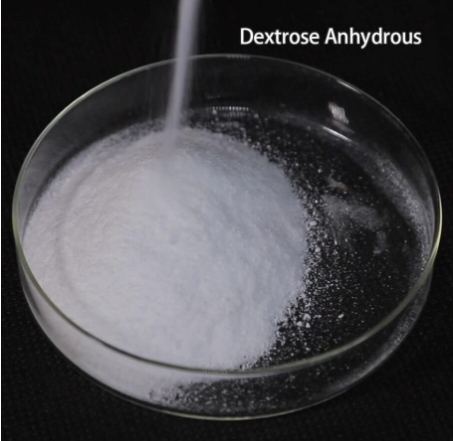
| Appearance | White crystalline powder | Particle grade varies |
| Water solubility | Soluble in water | Preparation behaviour depends on conditions and particle grade |
| Assay definition | 97.5–102.0% dextrose | USP published definition; anhydrous basis |
| Moisture | Controlled by the chosen specification | Anhydrous does not mean moisture cannot be present |
| Particle-size distribution | Fine, medium or other specified crystalline grade | Use actual distribution data for process selection |
| Identity / optical properties | D-glucose identity and specified optical tests | Follow the applicable standard |
| Related sugars / inorganic impurities | Controlled by the applicable grade | Review the current specification and COA |
| Special-use quality | Microbial / endotoxin requirements where applicable | Sterile-process suitability needs specific qualification |
Identity and published standard
USP–NF: Dextrose
The published definition covers anhydrous and monohydrate dextrose and specifies 97.5–102.0% dextrose, calculated on the anhydrous basis. This product page identifies the anhydrous form.
View published monographA published standard describes the material; conformity of the offered grade is confirmed through its current specification and COA.
For further information and current COA/specification, please contact us.
Request current COA & specificationApplications & functional benefits
Oral solid products
Used in suitable tablets, chewables, granules and related products as a carbohydrate or sweetening ingredient. Processing performance must be assessed for the offered particle grade.
Liquid formulations
Provides soluble carbohydrate and sweetness in compatible syrups and other oral liquids. Dissolution and finished-product characteristics are assessed at the intended concentration.
Effervescent and moisture-sensitive development
The absence of crystal water can be useful when designing dry systems. This does not eliminate the need for moisture control, compatible packaging and product stability assessment.
Anhydrous dextrose versus dextrose monohydrate
| Property | Anhydrous form | Monohydrate form |
|---|---|---|
| Formula | C₆H₁₂O₆ | C₆H₁₂O₆·H₂O |
| Formula weight | 180.16 g/mol | 198.17 g/mol |
| Crystal water | No stoichiometric molecule of water | One molecule of crystal water |
| Formulation implication | Account for measured moisture and assay | Account for crystal water plus the stated assay basis |
Formulation & processing
Check the hydration form before substitution
An equal weight of monohydrate and anhydrous material does not provide the same theoretical amount of glucose. Any substitution needs the approved formula calculation and the actual batch assay.
Match particle grade to manufacturing
Confirm the particle-size method, distribution and relevant bulk properties. Assess blend uniformity, dissolution or granulation in the actual process. Direct-compression performance cannot be established by chemical assay alone.
Separate general and specialised applications
For sterile manufacturing, request the specific grade and required endotoxin and microbiological evidence. For other specialised uses, define the suitability criteria at the enquiry stage instead of relying on a generic dextrose name.
What to check in the specification
- Identity and optical characteristics where specified: establish D-glucose identity.
- Assay on the stated basis and water content: distinguish chemical content from moisture.
- Related sugars: assess the applicable chromatographic impurity profile.
- Relevant inorganic impurities and residue: compare with the intended grade specification.
- Particle-size distribution and microbial quality: match the manufacturing process and end use.
Current product documentation
Request the current COA, specification, SDS, moisture and particle-grade details. Add microbial, endotoxin or other special requirements only where needed for the intended qualified application.
Request documents for Dextrose AnhydrousPacking, storage & handling
Packing and quotation details
State the required pack size, total quantity and delivery location. SBS will confirm the offered manufacturer, grade, net weight, packing and lead time. Request a sample and particle-size information when qualifying a new source for a solid formulation.
Storage and safe handling
Keep dry in well-closed packaging and prevent moisture uptake during storage and dispensing. Protect from contamination, close opened packs promptly and minimise dust. Follow the manufacturer’s SDS, storage instructions and retest or shelf-life information.
Frequently asked questions
Is dextrose the same ingredient as D-glucose?
Dextrose is D-glucose. The product name must additionally identify whether the purchased crystalline material is anhydrous or monohydrate.
Can anhydrous dextrose still contain moisture?
Yes. “Anhydrous” describes the hydration form. The batch moisture or water result is separately controlled and reported under the selected specification.
Is every grade suitable for direct compression or injection manufacture?
No. Those applications require a suitable grade and performance or quality evidence. Include the intended process and relevant requirements in the enquiry.
Technical information sources
Need more information?
Contact SBS for further product details, current COA, specification, packing and a quotation for your requirement.
Contact SBS for details and documents