
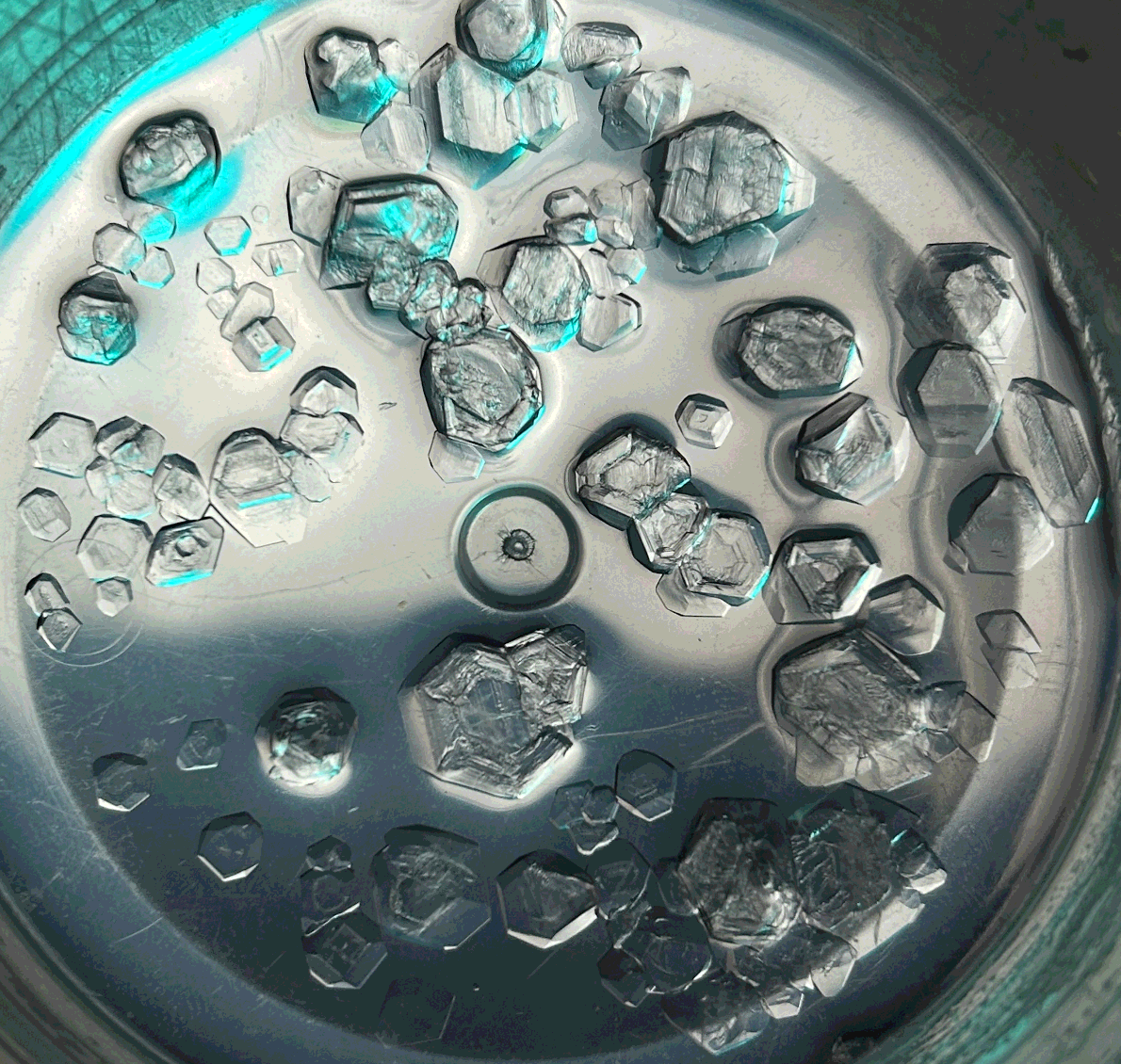
Understanding the material
The material occurs as colourless crystals or white crystalline powder and dissolves readily in water. Granulation affects handling, dissolving and blending. When switching between monohydrate and anhydrous citric acid, the difference in formula weight and water contribution must be included in the formulation assessment.
Product Identity & Specifications
Chemical identity, physical characteristics and key specifications for Citric Acid Monohydrate.
| Parameter | Description / value | Basis / application |
|---|---|---|
| Chemical identity | Citric acid monohydrate | Organic acid with one molecule of crystal water |
| CAS number | 5949-29-1 | Monohydrate form |
| Molecular formula | C₆H₈O₇·H₂O | Hydrated citric acid |
| Molecular weight | 210.14 g/mol | Monohydrate |
| Appearance | Colourless crystals or white crystalline powder | Various granulations |
| Water solubility | Very soluble | General material property |
| Ethanol solubility | Freely soluble in ethanol (96%) | General material property |
| Assay definition | 99.5–100.5% C₆H₈O₇ | USP published definition; anhydrous basis |
| Hydration behaviour | May lose crystal water in dry air | Efflorescence |
| Food-additive designation | E330 | Use requires the appropriate food grade |
| Particle grade | Selected granulation or specified size distribution | Match dissolution and blending requirements |
| Quality controls | Water, solution appearance and specified impurities | Use the selected standard and current COA |
Identity and published standard
USP–NF: Citric Acid Monohydrate
The published definition identifies citric acid with one molecule of water of hydration and specifies 99.5–100.5% C₆H₈O₇, calculated on the anhydrous basis.
View published monographA published standard describes the material; conformity of the offered grade is confirmed through its current specification and COA.
For further information and current COA/specification, please contact us.
Request current COA & specificationApplications & functional benefits
Pharmaceutical pH adjustment
Used in compatible liquid and other formulations where acidity needs to be controlled. Establish the amount through the formulation’s target pH and stability requirements.
Citrate buffer systems
Used with an appropriate citrate salt to prepare a buffer. The acid-to-salt ratio, concentration and other ingredients influence the achieved pH.
Chelation, food and industrial uses
Functions as a chelating agent and acidulant in suitable applications. Food, personal-care and industrial enquiries should specify the end use and the corresponding grade requirements.
Monohydrate versus anhydrous citric acid
| Property | Monohydrate | Anhydrous |
|---|---|---|
| Formula | C₆H₈O₇·H₂O | C₆H₈O₇ |
| Formula weight | 210.14 g/mol | Approximately 192.12 g/mol |
| Crystal water | One molecule per molecule of acid | No stoichiometric crystal water |
| Grade selection | Account for hydration and granulation | Often considered for dry blends; qualify for the actual process |
Formulation & processing
Control pH in the complete product
Citric acid content and measured pH are different parameters. Assess pH at the intended concentration in the finished system; do not use a raw-material assay as a substitute for product pH testing.
Account for crystal water
Changing hydration form alters the acid-equivalent amount in a weighed quantity. Use the approved calculation and current assay; consider the effect of added crystal water in moisture-sensitive blends.
Choose granulation for the operation
Discuss the particle-size distribution needed for dissolving, dry mixing or granulation. In reactive dry mixtures, include humidity, packaging and stability in the process assessment.
What to check in the specification
- Identity, assay and water content: read the assay on its stated anhydrous basis.
- Solution appearance and relevant impurity tests: compare with the applicable grade specification.
- Oxalate or other specified organic impurities: review where required by the chosen standard.
- Residue and relevant elemental impurities: use the offered grade’s current test evidence.
- Particle-size distribution and microbial requirements: select for the manufacturing process.
Current product documentation
Request the current COA, full specification, SDS and granulation details. State whether pharmaceutical, food or industrial documentation is required, and include any specific impurity or microbiological criteria.
Request documents for Citric Acid MonohydratePacking, storage & handling
Packing and quotation details
Include the required pack size, total quantity and granulation in the enquiry. SBS will confirm manufacturer, origin, packing format and delivery terms. Where the material is for a dry blend, discuss the required moisture protection and sample evaluation.
Storage and safe handling
Store in well-closed packaging under the manufacturer’s conditions. Avoid uncontrolled moisture changes and contamination. Minimise dust and avoid eye contact during handling; follow the current SDS. Keep the material appropriately separated from incompatible ingredients until the controlled manufacturing step.
Frequently asked questions
Can citric acid monohydrate replace the anhydrous form by equal weight?
Not automatically. Their formula weights and crystal-water contents differ. The formulation calculation and suitability need to be reviewed.
Is citric acid alone a complete citrate buffer?
A citrate buffer normally combines the acid with a suitable citrate salt or an equivalent neutralisation approach. The target pH and concentration determine the system.
Which details should a buyer specify?
Include the intended application, required pharmacopoeial or food standard, granulation, quantity and packing. Request current COA, specification and SDS for the material offered.
Technical information sources
Need more information?
Contact SBS for further product details, current COA, specification, packing and a quotation for your requirement.
Contact SBS for details and documents